
How to Choose the Right Plastic Packaging for Your Product
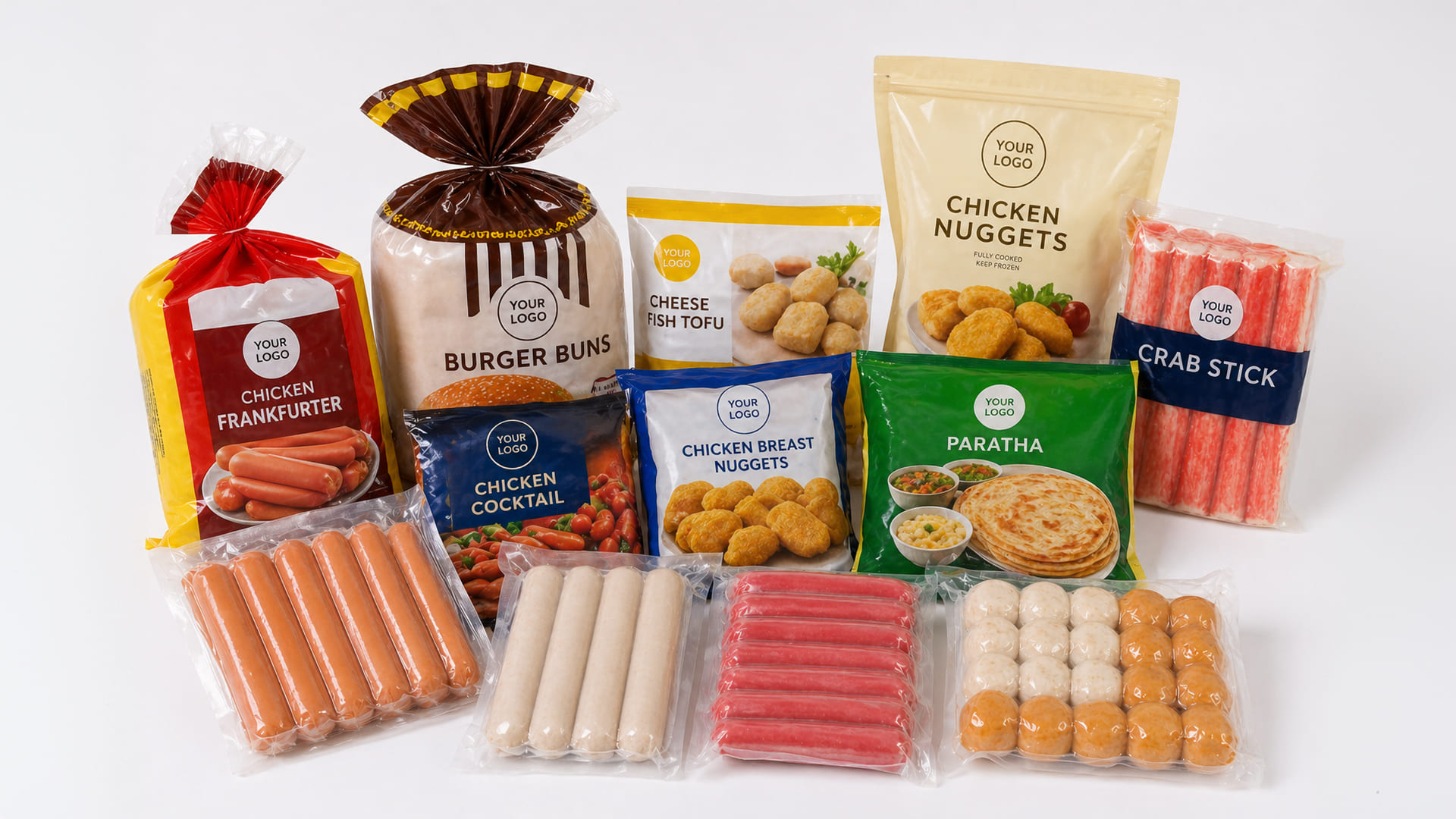
Choosing the right plastic packaging starts with understanding your product requirements, handling conditions, storage environment, and branding needs.
A packaging structure that works well for fresh produce may fail completely for frozen food, fertiliser, or retail food packaging. Material type, thickness, sealing performance, print requirements, and recyclability all affect whether the packaging performs properly during storage, transport, and daily operations.
This guide explains how businesses in Malaysia choose suitable plastic packaging based on real operational requirements, including bag type, material selection, thickness, packaging format, printing, and recyclability considerations.
Businesses commonly use this guide when sourcing:
- Custom plastic bags
- Printed laminated packaging
- Food packaging
- Retail carry bags
- Frozen food packaging
- Heavy-duty industrial bags
- Recyclable monomaterial packaging
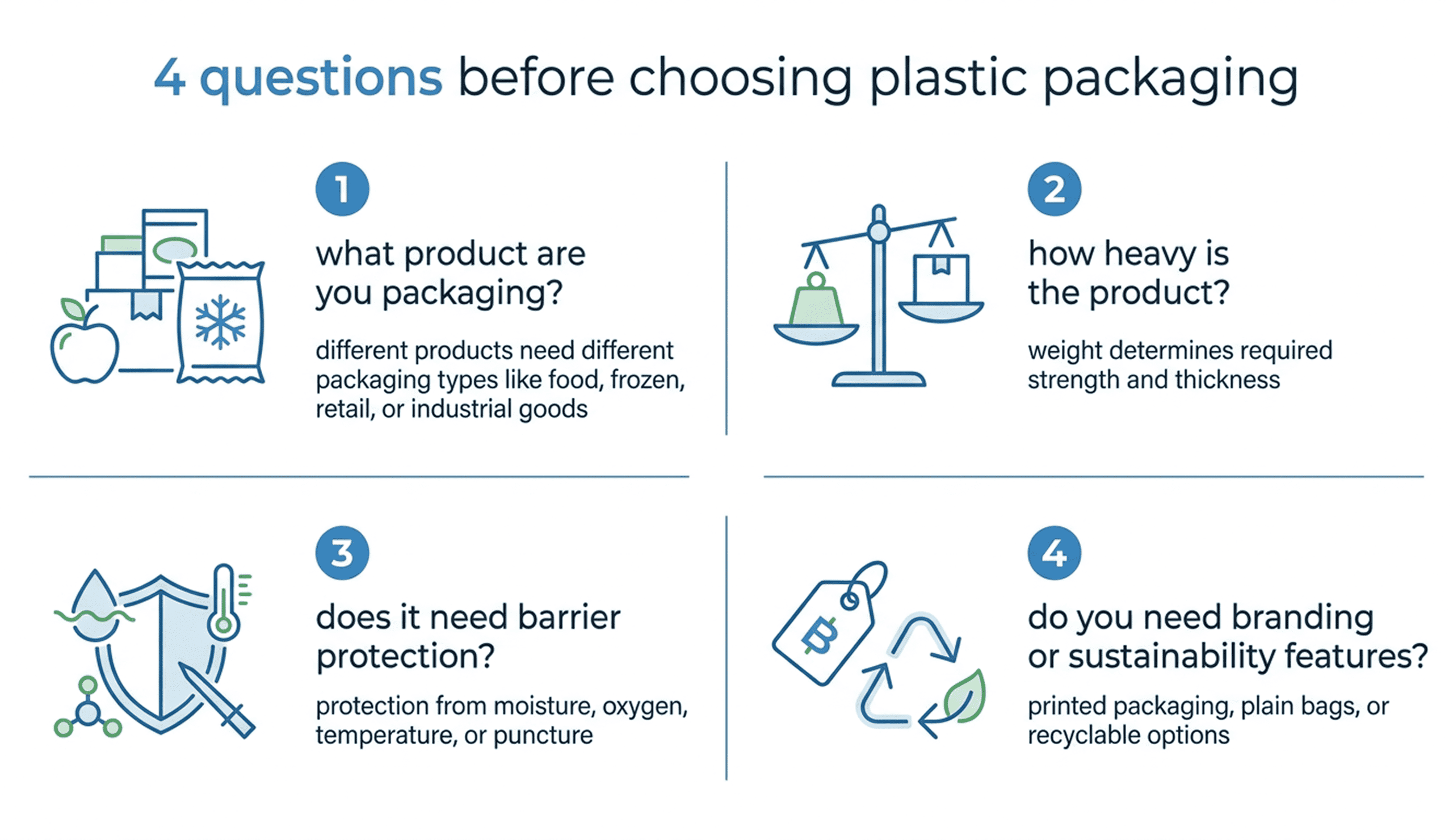
Start Here: 4 Questions Before Choosing Plastic Packaging
Before selecting a bag type or material, answer these four questions first.
Your answers determine which packaging structures are suitable for your application.
1. What product are you packaging?
Different products require completely different packaging structures.
For example:
| Product Type | Typical Packaging Requirement |
|---|---|
| Fresh produce | Breathability and lightweight handling |
| Frozen seafood | Cold resistance and puncture protection |
| Rice and flour | Moisture barrier and print quality |
| Fertiliser | Heavy load strength |
| Retail products | Branding and shelf presentation |
The first step is always understanding how the product will be packed, stored, transported, and sold.
2. How heavy is the product?
Product weight directly affects material strength and thickness requirements.
A 500g snack pouch requires very different structural performance compared to a 25kg fertiliser bag. Handling conditions also matter. Packaging used for pallet stacking and long-distance transportation must withstand more stress than packaging used only for retail display.
3. Does the product need barrier protection?
Some products require protection from moisture, oxygen, aroma loss, puncture, or low temperatures.
For example, frozen food requires oxygen and moisture resistance, vacuum packaging needs strong barrier protection, and dry food requires moisture control. Barrier needs often determine whether laminated structures are required.
4. What are your branding and sustainability requirements?
Do you need your logo, product information, or branding printed on the packaging? Does your business have ESG commitments or sustainability requirements that affect packaging selection?
Some businesses require retail-ready printed packaging, while others only need functional packaging for internal operations or logistics.
These requirements determine whether you need printed laminated packaging, plain bags, or recyclable monomaterial packaging.
Recyclability may also be important for ESG reporting, retailer requirements, or export compliance.
Step 1: Choose the Right Bag Type
The bag type is the foundation of the packaging specification.
Using the wrong bag type creates operational problems even if the material itself is good.
| Bag Type | Best For | Typical Material |
|---|---|---|
| Carry bag / T-shirt bag | Retail, supermarkets | HDPE |
| Calendar bag | Retail and promotional use | HDPE / LDPE |
| Bottom seal bag | General packaging | HDPE / LDPE |
| Produce roll | Fresh produce counters | HDPE |
| Garbage bag | Waste management | HDPE / LDPE |
| Laminated food bag | Rice, flour, dry food | PET/PE or PE+PE |
| Heavy-duty agricultural bag | Fertiliser, soil, pet food | PE/PE or PP/PE |
| Frozen food packaging | Frozen seafood and meat | Nylon/PE |
| Vacuum packaging | Perishables | Nylon/PE |
| Flexible pouch | Retail food packaging | PE+PE or PP+PP |
Not sure which bag type fits your application? Tell us your product, fill weight, and how the bags will be used. Our team will recommend the appropriate bag type and specification.
Step 2: Select the Right Material
The material determines:
- strength
- flexibility
- barrier performance
- sealing performance
- recyclability
- print quality
Below are the most common plastic packaging materials used in Malaysia.
HDPE — High-Density Polyethylene
HDPE is commonly used for:
- carry bags
- grocery bags
- produce rolls
- garbage bags
It is lightweight, stiff, and cost efficient.
HDPE is widely used in supermarkets and retail operations because it offers good strength while using less material weight.
Key advantages:
- strong for its weight
- lightweight
- cost efficient
- recyclable through PE streams
LDPE — Low-Density Polyethylene
LDPE is softer and more flexible than HDPE.
It is commonly used for:
- soft retail bags
- liner bags
- flexible inner packaging
- food packaging such as sugar and flour
LDPE stretches more under stress and provides a softer feel compared to HDPE.
Key advantages:
- flexible
- softer texture
- good sealing performance
- suitable for flexible packaging applications
PET/PE Laminated Structure
PET/PE laminates are commonly used for:
- rice bags
- flour packaging
- dry food packaging
- branded retail food bags
PET provides:
- strong print quality
- glossy appearance
- dimensional stability
PE provides:
- moisture resistance
- heat sealability
This structure is widely used in retail food packaging where branding and shelf appearance are important.
Monomaterial PE+PE
PE+PE uses polyethylene for both material layers.
It is commonly used for:
- recyclable flexible packaging
- dry food pouches
- frozen food pouches
- retail packaging
The main advantage is improved recyclability because the structure remains within the PE recycling stream.
Businesses increasingly use PE+PE structures for:
- ESG initiatives
- sustainability reporting
- recyclable packaging goals
Nylon/PE (PA/PE)
Nylon/PE is widely used for:
- frozen food packaging
- vacuum packaging
- seafood packaging
- barrier packaging
Nylon provides:
- puncture resistance
- oxygen barrier protection
- cold resistance
PE provides sealability.
This structure performs well in frozen and vacuum applications where standard PE structures may not provide enough protection.
Heavy-Duty PE/PE and PP/PE Structures
Heavy-duty laminated structures are commonly used for:
- fertiliser bags
- potting soil packaging
- pet food bags
- industrial packaging
These structures are designed for:
- heavier fill weights
- rough handling
- pallet stacking
- logistics durability
Custom printing is also commonly used in these categories.
Step 3: Choose the Correct Thickness
Thickness is measured in micron (μm).
Choosing the correct thickness is important because:
- bags that are too thin may fail
- bags that are too thick increase unnecessary material cost
| Thickness | Common Use |
|---|---|
| 8–15 micron | Produce rolls, lightweight bags |
| 18–30 micron | Retail carry bags |
| 30–50 micron | Heavy retail bags |
| 50–80 micron | Industrial inner bags |
| 80–120+ micron | Fertiliser and heavy-duty packaging |
Two common mistakes when choosing thickness are:
- Choosing based on price instead of product weight. Thinner bags may reduce cost, but they can fail during real use and handling.
- Ignoring product shape. Items with sharp edges, corners, or uneven surfaces require thicker bags, even if they are not heavy.
If you are unsure, it is safer to choose one thickness level higher and test it under real handling conditions.
Step 4: Choose the Right Packaging Format
Packaging format affects operational efficiency and packing speed.
| Format | Best For |
|---|---|
| Loose bags | Manual packing |
| Perforated roll | Produce counters |
| Continuous roll film | Automated packaging machines |
| Stand-up pouch | Retail shelf display |
| Flat pouch (3-side seal) | Dry food, snacks, industrial pouches, sample packaging |
| Centre seal/pillow pouch | High-speed food packing, snacks, confectionery |
The correct format should match the actual packing process and operational workflow.
Step 5: Plain Bags or Printed Bags?
Businesses must also decide whether the packaging requires custom printing.
| Plain Bags | Printed Bags |
|---|---|
| Suitable for operational or internal use | Suitable for retail and branded products |
| Lower MOQ | Higher MOQ due to print setup |
| Faster lead time | Longer production lead time |
| Basic colour options | Multi-colour branding and product information |
| Lower overall cost | Higher setup and artwork requirements |
Custom printed packaging is commonly used for food packaging, fertiliser bags, retail carry bags, OEM products, and pet food packaging, where branding and product information are important.
Plain bags are usually more suitable for internal operations, produce counters, waste management, and general industrial applications where functionality is the main requirement.
If you require custom printed bags, including OEM and private label production, you can refer to our Printed Bag Manufacturer Malaysia page for more details on our printing capabilities, artwork requirements, and production lead times.
Step 6: Consider Recyclability
Monomaterial PE+PE packaging is increasingly used because it supports recyclability while maintaining practical packaging performance for many applications.
However, some products still require conventional multi-layer laminates for stronger barrier performance.
Recyclability is becoming increasingly important across:
- retail
- food manufacturing
- export markets
- ESG-focused businesses
Different packaging structures have different recycling compatibility.
| Material Structure | Recycling Compatibility |
|---|---|
| HDPE / LDPE single layer | Compatible with PE recycling |
| PE+PE monomaterial | Compatible with PE recycling |
| PP+PP monomaterial | Compatible with PP recycling |
| PET/PE laminate | Limited recyclability |
| Nylon/PE laminate | Limited recyclability |
Quick Reference: Recommended Packaging by Product Type
| Product Type | Recommended Packaging | Material |
|---|---|---|
| Retail carry bags | Carry bag / T-shirt bag | HDPE or PE+PE |
| Fresh produce | Produce roll | HDPE |
| Rice, flour, sugar | Laminated food bag | PET/PE or PE+PE |
| Frozen seafood | Frozen food packaging | Nylon/PE |
| Vacuum-packed food | Vacuum packaging | Nylon/PE |
| Snacks and confectionery | Stand-up pouch | PE+PE or PP+PP |
| Fertiliser and soil | Heavy-duty laminated bag | PE+PE or PP/PE |
| Pet food | Printed laminated bag | PE+PE or PP/PE |
| Garbage and waste | Garbage bag | HDPE / LDPE |
| Industrial operational packing | Bottom seal bag | HDPE / LDPE |
These are general recommendations only, and actual packaging specifications will depend on factors such as fill weight, storage conditions, shelf-life requirements, handling conditions, and machine compatibility.
If your product category is not listed, contact our team with your requirements and we will recommend a suitable packaging structure based on your application.
Frequently Asked Questions (FAQs)
What is the most important factor when choosing plastic packaging?
The most important factor is matching the packaging to the product’s actual requirements, including weight, storage conditions, handling, and barrier needs.
What is the difference between HDPE and LDPE plastic bags?
HDPE bags are stronger and more rigid, making them suitable for carry bags, grocery bags, and produce packaging. LDPE bags are softer and more flexible, which makes them better for applications that need stretch and flexibility such as inner packaging or lightweight food packaging.
How do I know what thickness (micron) I need for my plastic bags?
Thickness depends on your product weight, shape, and handling conditions. Light products need thinner bags, while heavy or sharp-edged products require thicker bags. If you are unsure, it is safer to choose a slightly thicker option and test it in real usage.
What plastic packaging is best for food products?
It depends on the food type. Dry foods often use laminated or recyclable monomaterial bags, frozen food usually requires stronger barrier materials, and vacuum-packed products need high oxygen barrier structures. The correct choice depends on shelf life and storage conditions.
Should I choose plain or printed plastic bags?
Choose plain bags for internal use or when branding is not needed. Choose printed bags when you need your logo, product information, or branding for retail or customer-facing packaging.
How much do custom plastic bags cost in Malaysia?
Pricing depends on material type, size, thickness, printing requirement, and order quantity. Plain bags are generally more cost-effective, while custom printed and laminated packaging will have higher production costs due to material and setup requirements.
How long does production take for custom plastic bags?
Standard lead time is usually 1 to 3 weeks for plain bags and around 2 to 4 weeks for printed packaging, depending on artwork approval and order complexity.
How do I know if my product can use recyclable packaging?
It depends on your product’s barrier needs, storage conditions, and shelf-life requirements. Monomaterial PE or PP packaging is suitable for many applications, but high-barrier products may still require multi-layer structures.
How can I get the right packaging recommendation for my product?
You can share your product type, fill weight, storage conditions, and estimated quantity. Our team can then recommend the most suitable material, thickness, and bag type for your application.
Do you provide both plain and printed packaging?
Yes. We manufacture both plain functional packaging for operational use and custom printed packaging for branding, OEM, and retail applications.
Ready to Find the Right Plastic Packaging for Your Product?
Enrich Package manufactures custom plastic bags and flexible packaging for businesses across Malaysia, including retail carry bags, produce rolls, food packaging, frozen food packaging, recyclable monomaterial packaging, and heavy-duty industrial bags.
With over 19 years of manufacturing experience and HACCP and ISO 9001:2015 certified production systems, our team can help recommend suitable packaging structures based on your actual product requirements.
Disclaimer:
We hope you found this article informative. Our content is intended for general informational purposes only and does not constitute advice or necessarily reflect the full range of services offered by Enrich Package (Malaysia) Sdn. Bhd.
Readers are advised to consult with a qualified industry professional and contact our experts for packaging recommendations specific to their individual business needs. While we strive for accuracy and completeness in our blog posts, we cannot guarantee they are error-free. Enrich Package (Malaysia) Sdn. Bhd. assumes no responsibility for any errors or omissions.