
Best Frozen Food Packaging Materials for Seafood, Meat & Frozen Products
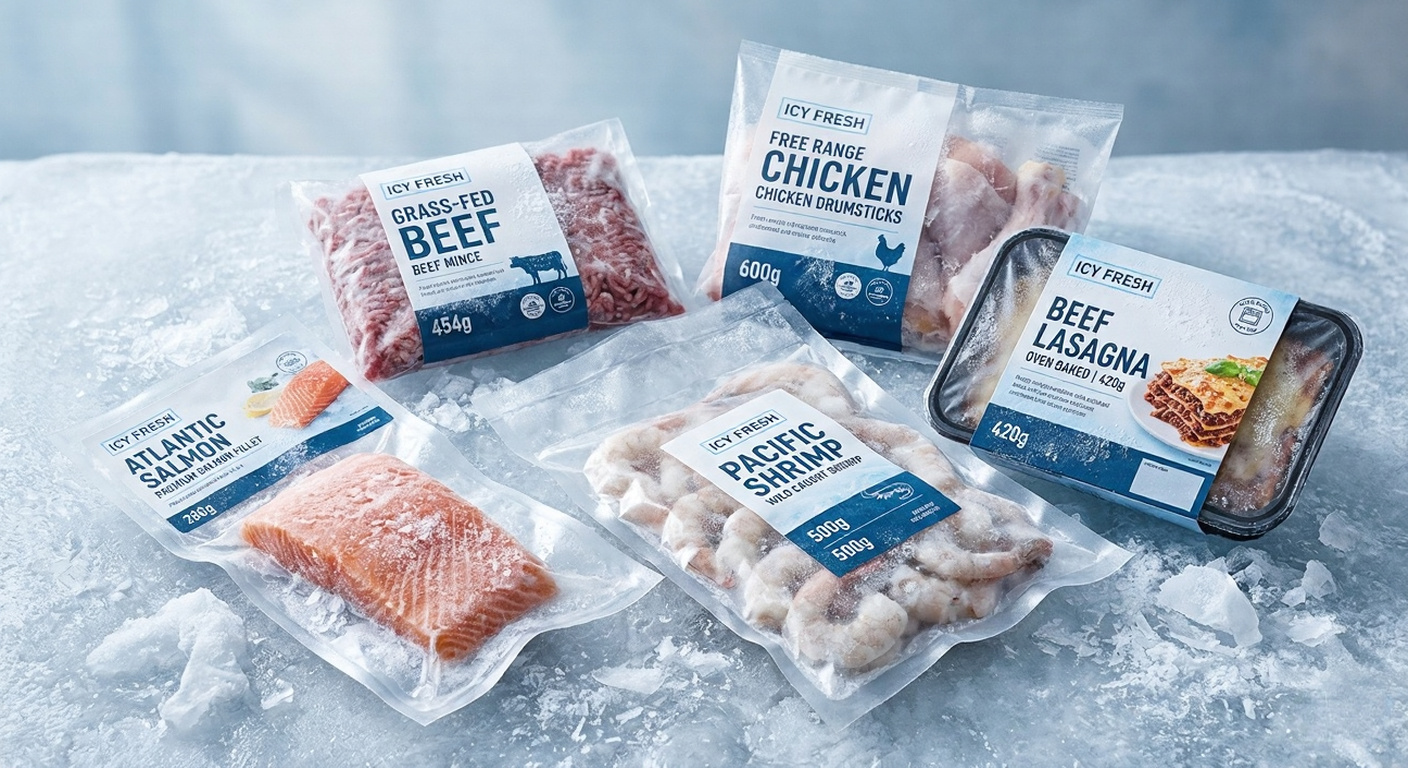
Frozen food packaging is not just about storing food at low temperature. It is a critical part of the cold-chain system that protects product quality from production to delivery. For seafood, meat, poultry, and ready-to-eat frozen meals, packaging must maintain structural integrity under freezing conditions while preserving freshness, safety, and appearance.
Unlike general plastic packaging used for retail or dry goods, frozen food packaging materials must perform under extreme conditions such as long-term freezing, moisture exposure, and physical stress during transportation and storage.
For food manufacturers, OEM brands, and exporters in Malaysia, selecting the right frozen food packaging material is a technical decision that directly affects shelf life, product safety, and customer experience.
This guide explains the most commonly used frozen food packaging materials, how they perform, and how businesses choose the right structure based on real operational requirements.
Why Frozen Food Packaging Materials Are Different
Frozen food packaging must perform under conditions that standard plastic packaging cannot handle.
During the frozen supply chain, packaging is exposed to:
- continuous low temperatures (often below -18°C)
- condensation during thawing and refreezing
- sharp product edges such as fish bones or meat cuts
- oxygen exposure leading to oxidation
- moisture loss that causes freezer burn
- stacking pressure during storage and transport
If the material is not suitable, packaging may become brittle, crack, lose seal strength, or fail to protect the product properly.
This is why frozen food packaging materials are usually engineered using laminated or multi-layer structures designed for durability and barrier protection.
Key Performance Requirements for Frozen Food Packaging
Before choosing a material, it is important to understand what frozen food packaging must achieve.
1. Cold Resistance
The material must remain flexible and strong at low temperatures without becoming brittle or cracking.
2. Puncture Resistance
Seafood, meat, and bone-in products can easily puncture weak packaging.
3. Barrier Protection
Packaging must reduce:
- oxygen exposure (prevents oxidation)
- moisture loss (reduces freezer burn)
- aroma loss (maintains product quality)
4. Seal Integrity
Strong sealing is required to prevent leakage, especially for vacuum and liquid-rich products.
5. Storage and Transport Durability
Packaging must withstand stacking pressure, handling, and long-distance logistics.
Common Frozen Food Packaging Materials
Nylon/PE (PA/PE) – The Industry Standard for Frozen Seafood and Meat
Nylon/PE is one of the most widely used frozen food packaging materials in Malaysia and global cold-chain industries.
This structure combines:
- Nylon (PA) for strength and barrier protection
- Polyethylene (PE) for sealing and flexibility
Why it is widely used
Nylon provides excellent puncture resistance, which is essential for products like frozen seafood and meat. It also helps protect against oxygen exposure, which extends shelf life and maintains product quality.
Common applications
- frozen seafood packaging
- frozen meat packaging
- vacuum packaging for frozen products
- poultry and bone-in products
- export-grade frozen food
Key advantages
- strong puncture resistance
- suitable for vacuum packaging
- good oxygen barrier performance
- stable under low temperatures
- reliable sealing performance
This material is often the preferred choice when product protection is more important than recyclability.
PET/PE – For Retail Frozen Food with Strong Branding
PET/PE laminated structures are commonly used for frozen food packaging that requires strong visual presentation.
PET provides:
- high-quality print surface
- glossy appearance
- good dimensional stability
PE provides:
- heat sealing capability
- moisture resistance
- Common applications
- frozen ready-to-cook meals
- frozen snacks and convenience food
- branded retail frozen food packaging
Key advantages
- excellent print quality for branding
- good shelf presentation
- suitable for retail packaging
- stable structure for light to medium frozen products
Compared to Nylon/PE, PET/PE is more focused on appearance and retail branding rather than heavy-duty puncture resistance.
Monomaterial PE+PE – Recyclable Frozen Food Packaging Option
Monomaterial PE+PE packaging is increasingly used as businesses move toward sustainable packaging solutions.
This structure uses polyethylene for all layers, making it compatible with PE recycling streams.
Common applications
- frozen snack packaging
- frozen processed food
- selected frozen convenience products
- recyclable frozen food pouches
Key advantages
- improved recyclability
- supports ESG and sustainability goals
- flexible under frozen conditions
- suitable for moderate barrier requirements
However, PE+PE may not fully replace high-barrier laminates for all frozen food applications, especially products requiring vacuum packaging or strong oxygen protection.
For more details, you can explore our guide on Recyclable Plastic Bag Manufacturer Malaysia
Vacuum Packaging Materials for Frozen Food
Vacuum packaging is widely used in frozen food applications to extend shelf life and reduce oxidation.
This process removes air from the packaging before sealing, helping to:
- reduce freezer burn
- prevent oxygen exposure
- slow down oxidation
- maintain product texture and flavour
Most common material
Nylon/PE (PA/PE) is the preferred material for vacuum frozen food packaging due to its strength and barrier performance.
Typical products
- frozen seafood
- frozen meat cuts
- marinated frozen products
- export frozen food items
Vacuum packaging is especially important for long storage durations and export markets.
Choosing the Right Frozen Food Packaging Material
Selecting the correct material depends on several key factors. Businesses usually evaluate packaging based on real production and logistics requirements.
1. Product Type
Different products require different packaging structures:
- Seafood and meat: require puncture resistance
- Snacks and convenience food: require branding and retail display
- Processed frozen food: may use recyclable or laminated structures
2. Storage Conditions
Frozen storage temperature affects material performance. Packaging must remain stable at low temperatures without cracking or losing seal strength.
3. Shelf Life Requirements
Longer shelf life often requires stronger barrier protection against oxygen and moisture.
4. Packaging Method
The packaging process also influences material selection:
- vacuum sealing
- manual packing
- automated filling systems
- stand-up pouch packaging
Each method requires compatible sealing temperature and film structure.
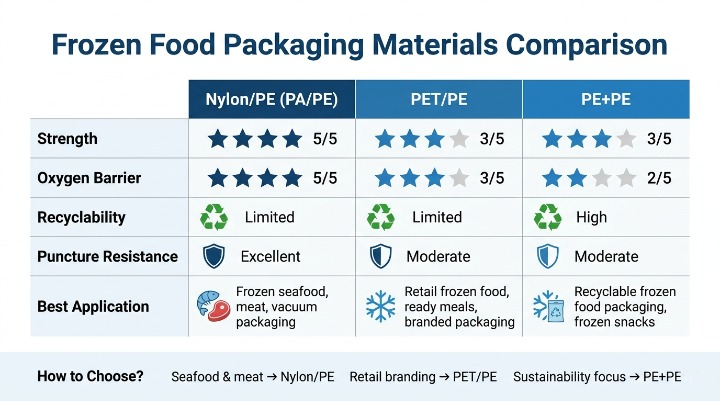
Frozen Food Packaging Materials Comparison
| Material | Strength | Barrier Protection | Recyclability | Common Use |
|---|---|---|---|---|
| Nylon/PE | High | High oxygen barrier | Limited | Seafood, meat, vacuum packaging |
| PET/PE | Medium | Medium | Limited | Retail frozen food |
| PE+PE | Medium | Moderate | High (PE stream) | Recyclable frozen pouches |
| HDPE/LDPE | Low–Medium | Low | High | Basic frozen or liner use |
Recyclability in Frozen Food Packaging
Sustainability is becoming increasingly important in food packaging.
Traditional materials like Nylon/PE and PET/PE provide strong performance but have limited recyclability due to mixed material layers.
Monomaterial PE+PE packaging offers an alternative for selected applications where recyclability is a priority while maintaining functional performance.
Many businesses adopt a hybrid approach:
- use recyclable materials where possible
- use high-barrier laminates where required
This allows better balance between performance and sustainability goals.
Frozen Food Packaging vs General Plastic Packaging
Frozen food packaging is engineered specifically for cold-chain performance.
Unlike general plastic packaging, it must withstand:
- freezing temperatures
- moisture exposure
- puncture risk
- long-term storage
- vacuum conditions
For example, HDPE carry bags or standard LDPE bags may perform well in retail use but are not suitable for frozen seafood or vacuum-packed products.
Frequently Asked Questions (FAQs)
What is the best material for frozen food packaging?
Nylon/PE (PA/PE) is widely considered the best material for frozen food packaging due to its puncture resistance, sealing strength, and oxygen barrier properties.
Can PE+PE packaging be used for frozen food?
Yes, PE+PE can be used for selected frozen food applications, especially where moderate barrier protection is sufficient and recyclability is a priority.
Why is Nylon/PE commonly used for frozen seafood?
Frozen seafood often has sharp shells or bones. Nylon/PE provides strong puncture resistance and helps prevent packaging failure during storage and transport.
Is frozen food packaging recyclable?
It depends on the material. PE+PE structures are recyclable within PE streams, while Nylon/PE and PET/PE have limited recyclability due to mixed materials.
What is vacuum packaging for frozen food?
Vacuum packaging removes air before sealing, helping reduce freezer burn, oxidation, and moisture loss. It is commonly used for seafood and meat products.
How do I choose the right frozen food packaging material?
The choice depends on your product type, storage conditions, shelf life requirements, and packaging method. A packaging supplier can recommend the most suitable structure based on these factors.
Not Sure Which Frozen Food Packaging to Use?
Enrich Package manufactures frozen food packaging and flexible laminated packaging for seafood, meat, vacuum, and recyclable applications across Malaysia.
With 19 years of manufacturing experience and HACCP & ISO 9001:2015 certified production systems, we help businesses select suitable packaging materials based on product requirements and cold-chain conditions.
Disclaimer:
We hope you found this article informative. Our content is intended for general informational purposes only and does not constitute advice or necessarily reflect the full range of services offered by Enrich Package (Malaysia) Sdn. Bhd.
Readers are advised to consult with a qualified industry professional and contact our experts for packaging recommendations specific to their individual business needs. While we strive for accuracy and completeness in our blog posts, we cannot guarantee they are error-free. Enrich Package (Malaysia) Sdn. Bhd. assumes no responsibility for any errors or omissions.