
What Thickness (Micron) Should Plastic Bags Be?
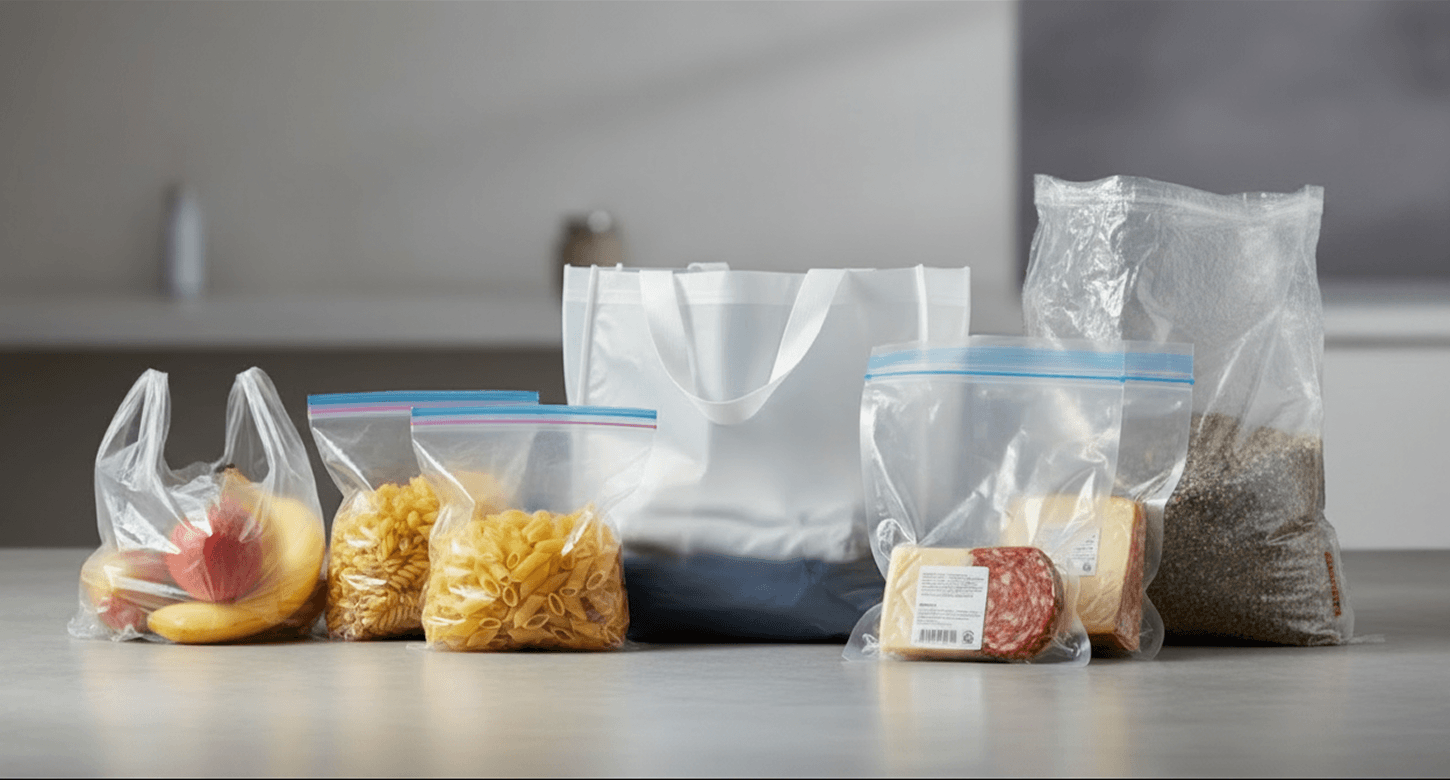
Choosing the right plastic bag thickness isn’t simply about selecting the highest micron. The ideal thickness depends on several factors, including the product’s weight, shape, packaging method, storage conditions, transportation requirements, material selection, and the intended application.
As a general guide:
- 8–15 micron is commonly used for lightweight produce rolls, bakery bags, and thin produce bags.
- 18–30 micron is suitable for many supermarket carry bags, takeaway bags, and convenience store bags.
- 30–50 micron is often used for premium shopping bags, reusable retail bags, and applications involving repeated handling.
- 50–80 micron is commonly used for industrial liner bags, warehouse packaging, and medium-duty industrial applications.
- 80–120+ micron is commonly used for heavy-duty applications such as fertiliser bags, potting soil packaging, animal feed, and bulk industrial products.
These ranges should be treated as general guidelines rather than fixed specifications. The most suitable micron depends on the complete packaging application rather than the product category alone.
A bag that is too thin may tear during filling, transportation, or storage, while one that is unnecessarily thick increases material costs without providing meaningful performance benefits. In many cases, the type of plastic material, bag design, sealing quality, and manufacturing consistency have just as much influence on performance as the micron rating itself.
This guide explains how plastic bag thickness is measured, how micron specifications are commonly used in Malaysia, and how packaging manufacturers determine the most appropriate thickness for retail, food, frozen food, industrial, and heavy-duty packaging applications.
What Does “Micron” Mean in Plastic Packaging?
Micron (μm) is the standard unit used to measure the thickness of plastic film.
One micron equals 0.001 millimetres (mm). For example, a 50-micron plastic bag has a film thickness of 0.05 mm.
In general, the higher the micron value, the thicker the plastic film. While the difference between 20 and 30 microns may seem small, even a slight increase in thickness can significantly improve a bag’s strength, durability, puncture resistance, and overall performance depending on the material used.
In Malaysia, plastic bag thickness is almost always specified in microns when discussing:
- Retail carry bags
- Produce rolls
- Food packaging
- Flexible packaging films
- Industrial liner bags
- Laminated packaging
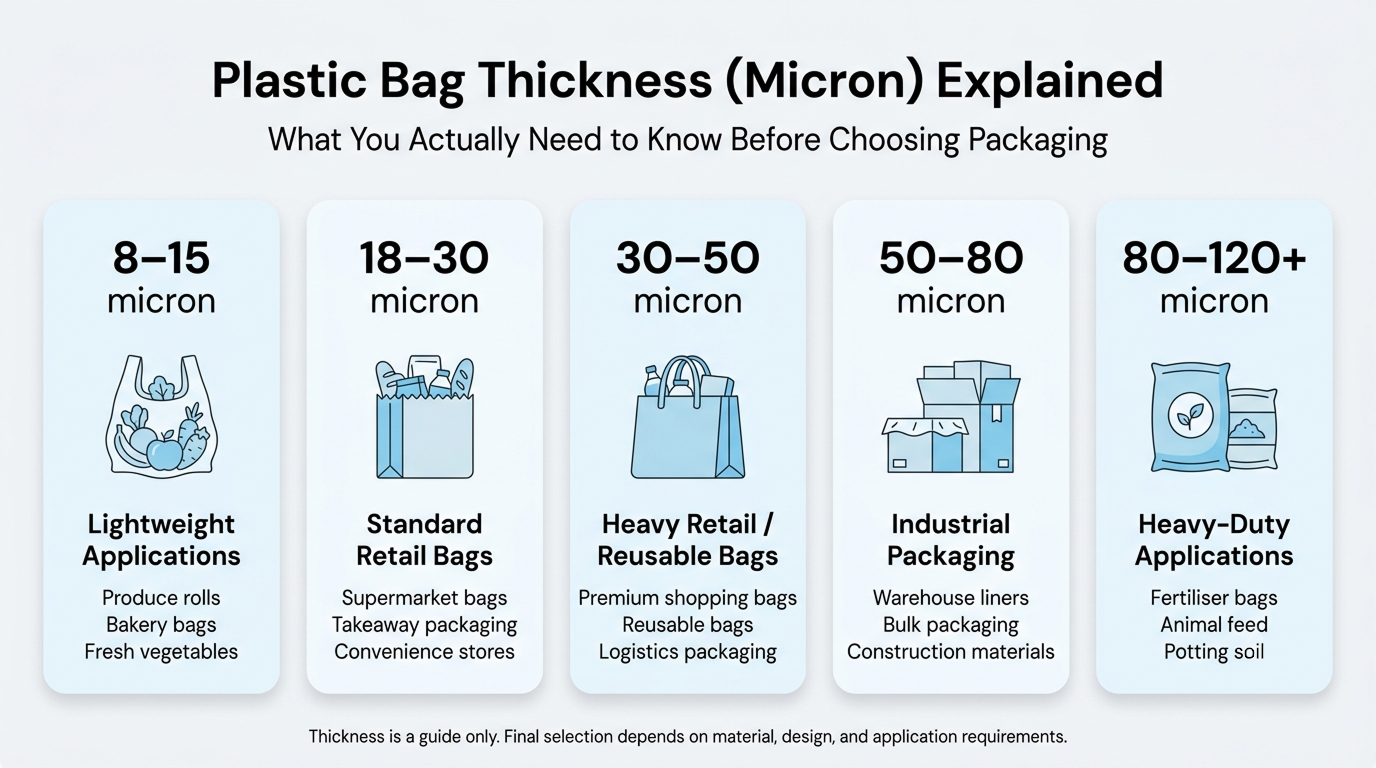
The table below provides a general reference for common thickness ranges.
| Thickness | Common Applications |
|---|---|
| 8–15 micron | Produce rolls, lightweight produce bags, bakery bags |
| 18–30 micron | Supermarket carry bags, takeaway bags, convenience store bags |
| 30–50 micron | Premium shopping bags, reusable retail bags, logistics packaging |
| 50–80 micron | Industrial liner bags, warehouse packaging, bulk handling |
| 80–120+ micron | Fertiliser bags, potting soil packaging, heavy-duty industrial bags |
Note: These thickness ranges are intended as general guidelines rather than fixed specifications. The ideal micron depends on factors such as the product weight, intended application, handling conditions, and the required level of strength and durability.
Why There Isn't a Standard Micron for Every Plastic Bag
One of the biggest misconceptions is that every product has a “correct” micron.
In reality, there is no universal plastic bag thickness.
Two companies packaging similar products may use different micron specifications because their bag dimensions, plastic material, filling process, transportation methods, and performance requirements are different.
For example, one supermarket may use a 22-micron HDPE carry bag, while another uses a 35-micron LDPE bag. Neither specification is automatically better. Each has been selected based on the desired balance between carrying strength, flexibility, customer experience, and cost.
This is why experienced packaging manufacturers rarely recommend a plastic bag based solely on micron. Instead, they evaluate the complete application before recommending the most suitable specification.
How Manufacturers Determine the Right Plastic Bag Thickness
Many buyers begin by asking for a 50-micron or 80-micron bag because that’s what they previously purchased.
In reality, thickness is usually the final specification, not the starting point.
Before recommending a plastic bag, manufacturers first evaluate how the packaging needs to perform throughout its entire lifecycle—from production and filling to storage, transportation, retail display, and end use.
Several factors influence the final recommendation.
1. Product Type
Different products place different demands on packaging performance.
| Product | Packaging Priority |
|---|---|
| Fresh vegetables | Lightweight handling and breathability |
| Frozen seafood | Puncture resistance and cold performance |
| Rice and flour | Moisture protection and print quality |
| Fertiliser | High load capacity and durability |
| Retail merchandise | Appearance and carrying strength |
Understanding the product helps determine not only the required thickness but also the most suitable material and bag construction.
2. Product Weight
Product weight influences load requirements, but it is not the only factor.
Manufacturers generally evaluate:
- Total fill weight
- Carrying load
- Stacking pressure
- Transportation conditions
- Handling frequency
However, two products with the same weight may require very different packaging. For example, a 5 kg rice bag distributes weight evenly, while 5 kg of hardware creates concentrated stress points that increase puncture risk.
3. Product Shape
Product shape is often just as important as product weight.
Sharp edges, corners, bones, shells, and irregular surfaces create concentrated stress points that increase the risk of punctures and tears.
Common examples include:
| Product | Packaging Challenge |
|---|---|
| Frozen seafood | Sharp shells and ice crystals |
| Bone-in meat | Bone punctures |
| Hardware | Sharp corners and edges |
| Fertiliser granules | Continuous abrasion |
| Frozen ready meals | Rigid tray corners |
In many cases, a lighter product with sharp edges requires stronger packaging than a heavier product with smooth surfaces.
4. Storage and Transportation Conditions
Packaging must perform under real-world conditions, not just production tests.
Key factors include:
- Ambient storage
- Refrigerated storage
- Frozen storage (below -18°C)
- Outdoor exposure
- Long-distance transportation
- Pallet stacking
- Warehouse handling
For frozen applications, material selection becomes critical because some films become brittle at low temperatures. In such cases, increasing thickness alone may not solve performance issues.
5. Packaging Method
Different packaging systems place different demands on film performance:
- Manual filling
- Semi-automatic packing
- Form-fill-seal (FFS) machines
- Vacuum packaging
- Automatic sealing systems
High-speed production lines require consistent thickness, stable sealing performance, and reliable machine compatibility.
6. Material Selection
Thickness should never be evaluated independently of material type.
HDPE (High-Density Polyethylene)
- High stiffness
- Excellent strength-to-weight ratio
- Good load performance
- Efficient material usage
HDPE often achieves strong performance at lower micron levels.
LDPE (Low-Density Polyethylene)
- High flexibility
- Good stretchability
- Soft feel
- Excellent sealing performance
LDPE may require slightly higher thickness for equivalent strength.
LLDPE (Linear Low-Density Polyethylene)
- High toughness
- Excellent tear resistance
- Strong impact resistance
Widely used in industrial liners and heavy-duty applications.
Laminated Structures
Examples include PET/PE and PA/PE structures.
These improve:
- Puncture resistance
- Moisture and oxygen barrier
- Cold-chain performance
- Print quality
Laminates are commonly used in vacuum packaging and frozen food packaging, where performance depends on structure rather than thickness alone.
Continue Reading: HDPE vs LDPE vs PP vs PE: Choosing the Right Plastic Packaging Material
7. Cost and Performance
Selecting the right micron is ultimately about balancing performance and cost.
Reducing thickness can lower material cost, but if the packaging fails during handling or transport, the cost of product damage, downtime, and customer complaints is usually higher than the savings.
Conversely, over-specifying thickness increases material usage without delivering meaningful benefits.
Experienced manufacturers aim to optimise both material selection and thickness to achieve reliable performance with efficient cost.
Recommended Plastic Bag Thickness by Application
Although every packaging application should be evaluated individually, the following thickness ranges are commonly used across many industries.
8–15 Micron
Lightweight applications:
- Produce rolls
- Fresh fruits and vegetables
- Bakery bags
- Short-use retail packaging
18–30 Micron
Standard retail applications:
- Supermarket bags
- Pharmacy bags
- Convenience store bags
- Takeaway packaging
30–50 Micron
Heavy retail and reusable applications:
- Clothing store bags
- Premium shopping bags
- Medium-duty logistics bags
- Reusable retail packaging
50–80 Micron
Industrial applications:
- Warehouse liners
- Bulk packaging
- Construction material packaging
- Logistics liners
80–120+ Micron
Heavy-duty applications:
- Fertiliser bags
- Animal feed bags
- Potting soil packaging
- Industrial raw materials
Common Mistakes When Choosing Plastic Bag Thickness
Choosing Based Only on Price
Reducing thickness may lower initial cost, but packaging failure often leads to higher total cost due to product damage and waste.
Ignoring Real Handling Conditions
Testing conditions rarely reflect real-world stress such as stacking pressure, transport vibration, or cold storage.
Assuming Thicker Always Means Stronger
One of the biggest misconceptions in plastic packaging is assuming that a thicker bag is automatically a stronger bag.
In reality, overall performance depends on several factors, including:
- Plastic material
- Resin quality
- Bag design
- Seal quality
- Product shape
- Handling conditions
- Manufacturing consistency
For example, a well-designed HDPE carry bag may outperform a thicker LDPE bag in certain retail applications. Likewise, frozen seafood packaging often relies more on puncture-resistant materials and laminate structures than simply increasing film thickness.
Thickness is important — but it should always be considered alongside material selection and the intended application.
Why Two Manufacturers May Recommend Different Microns
There is no single correct micron for every application.
Different manufacturers may recommend different specifications due to variations in:
- Material selection
- Production technology
- Resin formulation
- Design standards
- Quality control systems
- Application experience
This is why micron should be treated as one part of a full packaging design—not the only decision factor.
Frequently Asked Questions (FAQs)
What affects the price of plastic bags?
The price of plastic bags depends on several factors, including material type (HDPE, LDPE, LLDPE, or laminated structures), micron thickness, bag size, printing requirements, resin cost, and order quantity. Custom specifications, such as heavy-duty or multi-layer packaging, may also affect the final price.
What thickness (micron) should plastic bags be for retail use?
Most retail plastic bags typically range from 18–30 micron for HDPE bags and 25–50 micron for LDPE bags, depending on load weight, bag size, and handling requirements. Heavier retail items may require thicker films or stronger materials.
Is higher micron always better for plastic bags?
Not necessarily. A higher micron can improve strength, but performance also depends on material type, bag design, sealing quality, and product shape. In some cases, a well-designed lower micron HDPE bag can outperform a thicker LDPE bag.
What micron is suitable for frozen food packaging?
Frozen food packaging commonly uses laminated structures or LDPE/LLDPE films, typically in the range of 50–100+ micron depending on product weight and puncture risk. Material flexibility at low temperatures is often more important than thickness alone.
What is the difference between HDPE and LDPE in plastic bags?
HDPE is stiffer and offers higher strength at lower thickness, making it suitable for lightweight carry bags. LDPE is softer, more flexible, and has better sealing performance, often requiring slightly higher micron for similar strength.
Can thinner plastic bags reduce packaging cost?
Yes, reducing thickness can lower material cost, but only if performance is not compromised. If a bag fails during transport or handling, the cost of product damage and waste is usually higher than the material savings.
How to choose a reliable plastic bag supplier?
A reliable plastic bag supplier should offer application-based recommendations, consistent product quality, and stable manufacturing standards. Strong experience across industries, deep material knowledge, and the ability to customise packaging solutions are also key indicators of a dependable supplier.
With over 19 years of experience, Enrich Package supports customers in selecting the right plastic bag specifications based on real application needs, not just standard thickness charts.
Why do different suppliers recommend different micron sizes?
Different suppliers may use different materials, resin quality, manufacturing standards, and design assumptions. This is why the same product may have different recommended micron specifications depending on the manufacturer.
How do I choose the right plastic bag thickness?
The right thickness depends on product weight, shape, storage conditions, transportation method, and material type. Contact Enrich Package for professional advice on selecting the most suitable plastic bag specification for your application.
Not Sure Which Micron Is Right for Your Packaging?
Selecting the right plastic bag thickness involves more than choosing a number from a chart. It requires evaluating product characteristics, packaging processes, material selection, and real-world handling conditions.
With over 19 years of experience as a leading plastic bag manufacturer in Malaysia, Enrich Package has supported customers across food, agriculture, retail, and industrial sectors in developing packaging solutions that balance durability, performance, and material efficiency.
Whether you need retail carry bags, frozen food packaging, fertiliser bags, industrial liners, or custom flexible packaging, our team can help recommend a specification based on your actual application—not just micron alone.
Disclaimer:
We hope you found this article informative. Our content is intended for general informational purposes only and does not constitute advice or necessarily reflect the full range of services offered by Enrich Package (Malaysia) Sdn. Bhd.
Readers are advised to consult with a qualified industry professional and contact our experts for packaging recommendations specific to their individual business needs. While we strive for accuracy and completeness in our blog posts, we cannot guarantee they are error-free. Enrich Package (Malaysia) Sdn. Bhd. assumes no responsibility for any errors or omissions.