
Malaysia EPR 2030: What It Means for Your Packaging
Malaysia is moving towards Extended Producer Responsibility (EPR), which will place greater responsibility on producers for the products and packaging they put on the market, including what happens after those products are used.
For manufacturers, brand owners and packaging buyers, this means packaging decisions may increasingly involve more than cost, strength, printing and appearance.
Businesses may also need to understand:
- what materials their packaging contains
- how much packaging they place on the market
- whether the packaging can be recovered or recycled
- whether a more recycling-compatible structure is technically possible
Malaysia’s EPR framework is still developing, but the policy direction is already clear. The country is preparing for a transition from voluntary participation towards mandatory EPR by 2030.
This does not mean every business needs to change its packaging today. A more recyclable structure still needs to protect the product, seal properly, meet shelf-life requirements and work with existing production processes.
The practical first step is simpler: understand what packaging you currently use and where improvement may be possible.
What Is EPR and Why Does It Matter for Packaging?
Extended Producer Responsibility means a producer’s responsibility can extend beyond manufacturing and selling a product to include what happens after the product or packaging becomes waste.
Malaysia’s Plastics Sustainability Roadmap 2021–2030 describes EPR as extending the financial and/or physical responsibility of stakeholders across the plastics value chain, including product design and post-consumer treatment or disposal.
For a manufacturer, this changes the way packaging may need to be viewed.
A packaging team may currently ask:
What size do we need? How thick should it be? How many colours are we printing? What is the price per bag?
Under EPR, another question becomes increasingly important:
What is the packaging made from, and what happens to it after use?
Malaysia’s roadmap also proposes the use of a Producer Responsibility Organisation (PRO) to help manage EPR responsibilities such as collection, recovery and recycling.
EPR is different from ESG. ESG is a broader environmental, social and governance framework, while EPR is a specific producer-responsibility policy related to products and packaging after use.
What Is EPR and Why Does It Matter for Packaging?
Extended Producer Responsibility means a producer’s responsibility does not necessarily end when the product is sold.
Malaysia’s Plastics Sustainability Roadmap 2021–2030 describes EPR as extending the financial and/or physical responsibility of stakeholders across the plastics value chain. This includes product design as well as the treatment or disposal of products after consumers have used them.
Think about a company selling packaged food.
Today, its packaging team may mainly focus on whether the bag protects the food, seals properly, looks good on the shelf and meets the required cost.
Under EPR, the business may also need to understand how much packaging it places on the market, what materials the packaging contains, and what happens to that packaging after use.
Malaysia’s roadmap also proposes the use of a Producer Responsibility Organisation (PRO) to support the operation of an EPR scheme.
So EPR is not simply another recycling campaign. It introduces producer responsibility into the wider packaging lifecycle.
EPR is also not the same as ESG. ESG covers broader environmental, social and governance issues within a business, while EPR is a more specific policy approach concerning producer responsibility for products and packaging after use.
When Will EPR Become Mandatory in Malaysia?
Businesses may see different EPR dates when searching online because Malaysia’s implementation plan has evolved.
The original Malaysia Plastics Sustainability Roadmap 2021–2030 proposed a voluntary EPR phase before mandatory implementation.
More recent government and industry direction now points towards a longer transition, with voluntary participation and preparation before mandatory EPR by 2030.
Malaysia is also continuing to develop the broader circular economy ecosystem. KPKT has already carried out EPR pilot work, policy development and industry engagement, while MITI’s Circular Economy Policy Framework for the Manufacturing Sector includes a transition from voluntary to mandatory EPR.
| Period | What Businesses Should Know |
|---|---|
| Before 2026 | Policy development, pilots and industry preparation |
| From 2026 | Voluntary participation and transition |
| 2026–2030 | Wider industry preparation |
| By 2030 | Mandatory EPR targeted |
For businesses, the important takeaway is:
2030 should be treated as a preparation deadline, not the year to start learning about your packaging.
How Could EPR Affect Manufacturers and Brand Owners?
EPR is not only a recycling issue handled after a product leaves the factory.
It can influence packaging decisions much earlier.
Know What Your Packaging Is Made From
Many businesses buy packaging according to practical descriptions such as:
printed pouch, frozen food bag, 5 kg bag, heavy-duty packaging.
But these descriptions do not tell you what the packaging is actually made from.
A laminated pouch, for example, could be:
PET/PE, PA/PE, PE/PE or another structure.
They may look similar from the outside, but their recycling compatibility can be very different.
This makes accurate material specifications more valuable.
Instead of knowing only the bag type, businesses may increasingly need clearer information about the material structure behind the packaging.
If your team is unfamiliar with the differences, our guide to plastic packaging materials including HDPE, LDPE, PE and PP explains how common materials perform in different applications.
Keep Better Packaging Data
Businesses with multiple SKUs may also need better visibility over how much packaging they use.
For example, one product may use 2 million pouches a year while another uses only 30,000.
Knowing the material structure, packaging weight and annual quantity can help identify which packaging deserves attention first.
You do not need to redesign everything immediately.
Knowing what you currently use is already a useful first step.
Will EPR Affect Packaging Costs in Malaysia?
Cost is one of the biggest concerns for businesses preparing for EPR.
Malaysia has not yet published final mandatory fee rates for individual packaging structures.
However, the Malaysia Plastics Sustainability Roadmap 2021–2030 proposed an eco-modulated fee approach. Under this concept, producer contributions could consider factors such as:
- material type
- recoverability
- recyclability
- production volume
- turnover
These contributions are intended to support post-consumer activities such as collection, sorting, recycling and disposal.
This means businesses may eventually need to look beyond the purchase price of the packaging itself.
Consider a simple example.
A buyer is comparing two bags for the same product.
Option A: a conventional multi-material laminate that performs well but is difficult to recycle.
Option B: a monomaterial structure that also meets the required performance but is designed for better recycling compatibility.
Today, the buyer may mainly compare the unit price.
Under EPR, recyclability and future producer-responsibility costs could become additional considerations.
That does not mean Option B will automatically be cheaper. Malaysia’s final fee structure has not been announced, and packaging must still meet the product’s technical requirements.
The main point is:
Future packaging cost may involve more than the price paid per bag.
For high-volume packaging, even small differences can become significant across hundreds of thousands or millions of units.
Why Does Packaging Material Structure Matter?
Flexible plastic packaging can contain several layers because different materials provide different functions.
Some provide printability. Others provide sealing, strength or barrier performance.
From a recycling perspective, one important distinction is whether those layers remain within the same polymer family.
| Structure | What It Means for Recycling |
|---|---|
| PE/PE | Same polymer family; designed for better PE recycling compatibility |
| PP/PP | Same polymer family; designed for better PP recycling compatibility |
| PET/PE | Different polymer families; conventional recycling is more challenging |
| PA/PE | Different polymer families; recycling can be more challenging |
This is why simply saying that packaging is “plastic” does not tell you much about its recyclability.
For a deeper explanation, read our guide to mono-material vs multi-layer packaging.
PET/PE vs PE/PE: What Is the Practical Difference?
PET/PE is widely used because the different layers can provide useful packaging properties.
PET can support print quality and dimensional stability, while PE supports sealing and moisture resistance.
From a performance perspective, this can be a very effective structure.
The recycling challenge is that PET and PE belong to different polymer families.
PE/PE takes a different approach.
Different PE-based layers can perform different functions while keeping the main structure within the polyethylene family.
For suitable applications, this can improve compatibility with PE recycling streams.
But the decision should never be as simple as:
PET/PE = bad
PE/PE = good
The better question is:
Can PE/PE provide the strength, barrier, sealing, printing and storage performance this product actually needs?
If the answer is yes, a monomaterial structure may provide a practical opportunity to improve recyclability.
If not, a conventional laminate may still be required.
Should You Switch to Monomaterial Packaging Now?
Not necessarily.
Packaging exists first to protect the product.
Take snack food as a simple example.
Snack packaging often requires a strong barrier to protect the product from moisture and help maintain its crispy texture. In many conventional structures, a metallised PET layer is used to provide this barrier performance.
Removing or replacing this layer may make the packaging structure more compatible with recycling, but the new structure still needs to provide the barrier performance required to protect the product throughout its shelf life.
If a material change improves recyclability but causes the product to lose its quality or become less effectively protected, it has not solved the overall packaging problem.
A better question is:
Can we achieve the performance we need with a structure that is easier to recycle?
For some applications, PE/PE or PP/PP may be suitable.
For others, demanding barrier, temperature or mechanical requirements may still require a conventional multi-material structure.
This is why packaging changes should be based on both product performance and recyclability, not recyclability alone.
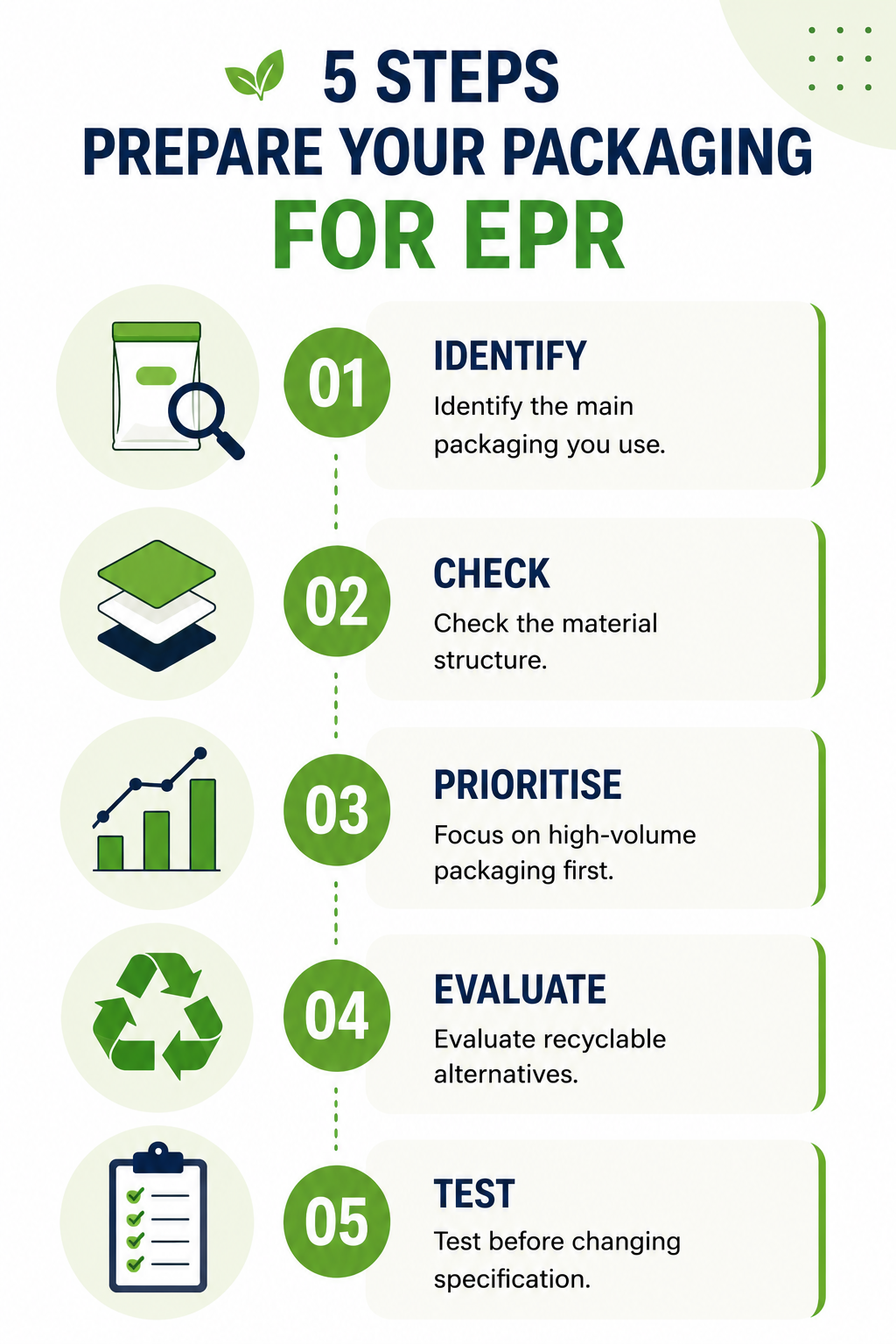
How Can Businesses Prepare for EPR Before 2030?
You do not need to wait for the final mandatory framework before improving your packaging visibility.
A practical starting point is:
1. Identify What Packaging You Currently Use
Start with your highest-volume products.
Record the material structure, thickness, approximate packaging weight and annual usage where possible.
Instead of recording only “laminated pouch”, try to identify whether it is PET/PE, PA/PE, PE/PE or another structure.
2. Review High-Volume Mixed-Material Packaging
If your business uses many different packaging formats, you do not need to review all of them at once.
Start with packaging that is used in high volumes or contains multiple material types.
For example, reviewing a pouch used two million times a year may have more impact than redesigning a specialised pack used only 20,000 times.
3. Understand Why Each Material Is Used
Do not remove a material simply because it makes recycling more difficult.
Ask what function it provides.
Is it needed for barrier protection, print quality, sealing, strength or puncture resistance?
Once you know the reason, it becomes easier to determine whether another structure can replace it.
4. Evaluate and Test Alternatives
Where technically suitable, ask whether PE/PE, PP/PP or another more recycling-compatible structure could meet the same requirements.
Any change should be tested under actual operating conditions before full production.
If you are reviewing a new specification, our guide on how to choose the right plastic packaging for your product explains the key factors to consider.
5. Maintain Clear Packaging Specifications
Keep updated information from your packaging suppliers.
Better material data can support future EPR preparation, supplier reviews, sustainability reporting and packaging optimisation.
What Should You Ask Your Packaging Supplier?
You do not need to become a polymer expert.
But your packaging supplier should be able to help you answer a few practical questions:
- What is the complete material structure?
- What function does each layer provide?
- Is a monomaterial option technically possible?
- Can the alternative be tested before full production?
For example, asking for “the same pouch but recyclable” is often not enough.
Your supplier needs to understand what you pack, how much it weighs, how it is sealed, how it is stored and what happens during transport before recommending a suitable structure.
How Can Enrich Package Help With Recyclable Packaging?
Preparing for EPR does not mean replacing every package immediately.
A more practical starting point is to understand your existing packaging and identify where a recycling-compatible alternative can meet the same requirements.
Enrich Package manufactures PE/PE and PP/PP monomaterial flexible packaging for suitable food, retail, agriculture and industrial applications.
When reviewing a packaging structure, our team considers factors such as product type, fill weight, sealing, barrier requirements, printing, storage conditions, transport and packing method.
If your business currently uses PET/PE, PA/PE or another mixed-material laminate, we can assess whether a monomaterial alternative may be technically suitable.
Explore our recyclable plastic packaging solutions in Malaysia to learn more about PE/PE and PP/PP packaging.
Frequently Asked Questions (FAQs)
What is EPR in Malaysia?
Extended Producer Responsibility is a policy approach that extends producer responsibility into the post-consumer stage, including areas such as recovery, recycling and end-of-life management.
When will EPR become mandatory in Malaysia?
Malaysia is moving through a voluntary transition towards mandatory EPR by 2030. Businesses should continue monitoring official updates as the detailed requirements are developed.
Is EPR a plastic tax?
No. EPR is a producer-responsibility framework. Malaysia’s Plastics Sustainability Roadmap proposed eco-modulated contributions to support post-consumer waste management.
Will recyclable packaging reduce EPR costs?
Malaysia’s roadmap proposed that material type, recoverability and recyclability could influence future contributions. However, final mandatory fee rates have not yet been publicly finalised.
What is monomaterial packaging?
Monomaterial packaging keeps the main packaging structure within one polymer family, such as PE+PE or PP+PP, to improve compatibility with the relevant recycling stream.
What is monomaterial packaging?
Monomaterial packaging keeps the main packaging structure within one polymer family, such as PE+PE or PP+PP, to improve compatibility with the relevant recycling stream.
How should my business start preparing for EPR?
Start by identifying the materials and quantities of packaging you currently use. Then review high-volume mixed-material packaging and assess alternatives where technically suitable.
Is Your Current Packaging Ready for the Next Step?
Malaysia’s move towards EPR gives manufacturers and brand owners a practical reason to understand their packaging materials now rather than waiting until mandatory requirements take effect.
You do not need to change every package.
Start by understanding what you currently use, why you use it and where a more recycling-compatible structure could realistically work.
If your business currently uses PET/PE, PA/PE or other multi-material packaging, share your existing packaging specification and application requirements with Enrich Package.
Our team can help assess whether a PE/PE or PP/PP monomaterial packaging solution is suitable for your product.
Disclaimer:
We hope you found this article informative. Our content is intended for general informational purposes only and does not constitute advice or necessarily reflect the full range of services offered by Enrich Package (Malaysia) Sdn. Bhd.
Readers are advised to consult with a qualified industry professional and contact our experts for packaging recommendations specific to their individual business needs. While we strive for accuracy and completeness in our blog posts, we cannot guarantee they are error-free. Enrich Package (Malaysia) Sdn. Bhd. assumes no responsibility for any errors or omissions.