
Mono-Material Packaging: What to Know Before You Switch
Mono-material packaging is becoming an important option for manufacturers and brand owners looking to improve the recyclability of flexible plastic packaging.
Instead of combining different polymer families such as PET and PE, mono-material packaging keeps the main packaging structure within one polymer family, such as PE or PP.
This can make the packaging easier to sort and process within the appropriate recycling stream. CEFLEX’s latest flexible packaging design guidance gives preference to mono-PE and mono-PP structures because they generally provide better sortability, recyclability, recycling yield and recyclate quality than mixed-material structures.
But that does not mean every PET/PE, PA/PE or other laminated package should immediately be replaced.
Your packaging still needs to protect the product, seal properly, run on your packing equipment and perform throughout storage and transportation.
So, is mono-material packaging right for your product?
The answer depends on what your packaging needs to do. Before switching, manufacturers should evaluate the existing material structure, product characteristics, barrier requirements, sealing, machinery, storage conditions and actual handling environment.
What Is Mono-Material Packaging?
Mono-material packaging is designed predominantly around one polymer family rather than combining several incompatible polymer types.
For flexible plastic packaging, two common approaches are:
- PE/PE, where the main layers are polyethylene-based
- PP/PP, where the main layers are polypropylene-based
This is different from structures such as PET/PE or PA/PE, which combine different polymer families to achieve specific packaging properties.
However, “mono-material” does not necessarily mean that literally every component is made from one identical resin.
A printed flexible package can still contain inks, adhesives, coatings, barrier layers, closures or other components. These can affect how the finished package performs during sorting and recycling.
For this reason, current design-for-recycling guidelines assess the complete packaging structure, rather than looking only at the main film.
RecyClass, for example, maintains separate design-for-recycling guidance for PE and PP flexible films and evaluates elements including barriers, laminating adhesives and printing inks. Its guidelines continue to be updated based on laboratory testing.
The key difference between mono-material and multi-layer packaging is therefore not simply the number of layers. A package can contain multiple layers and still follow a mono-material approach if those layers remain compatible with the intended recycling stream.
Why Are Manufacturers Considering Mono-Material Packaging?
Traditional flexible packaging often combines materials because different layers perform different jobs.
Take PET/PE as an example.
PET can provide stiffness, dimensional stability and good print performance, while PE provides sealing and moisture resistance. Together, they create a useful packaging structure.
The difficulty appears at end of life.
Because PET and PE belong to different polymer families, conventional mechanical recycling becomes more challenging once they are permanently laminated together.
Mono-material packaging approaches the problem differently.
Instead of relying on different polymer families, packaging developers try to achieve the necessary performance while keeping the main structure within PE or PP.
The objective is not simply to use fewer materials.
It is to:
maintain the functions the product needs while designing the package for better recycling compatibility.
This direction is becoming increasingly relevant as Malaysia moves towards greater Extended Producer Responsibility (EPR) and circular packaging practices. Malaysia’s Plastics Sustainability Roadmap includes EPR, sustainable design and increased use of recycled materials as part of the country’s transition towards plastics circularity.
And this is not only a future concept in Malaysia.
A Real Malaysia Example: Ajinomoto
Ajinomoto (Malaysia) Berhad began using mono-material packaging for its 72g AJI-NO-MOTO Umami Seasoning in May 2021.
According to the company, the new packaging consists of 90% of the same material and was introduced as part of its efforts to improve recyclability. Before implementation, Ajinomoto had studied replacing its existing OPP/PE-based packaging with a recyclable mono-material structure.
This is a useful example because it shows what a packaging transition looks like in practice.
A manufacturer does not simply decide that “recyclable is better” and replace the film. It first evaluates whether a different structure can continue performing the functions required by the product.
Is Mono-Material Packaging Suitable for Every Product?
No.
A packaging structure may have better recycling compatibility but still be unsuitable for a particular product.
Consider two very different applications.
A lightweight dry food product mainly needs reliable sealing, moisture protection and printed branding.
Frozen seafood, on the other hand, may need to withstand low temperatures, sharp shells, ice edges, puncture risk and demanding transport conditions.
The packaging requirements are not the same.
Likewise, a fertiliser bag carrying 20 kg or 25 kg has very different mechanical demands from a 200 g snack pouch.
That is why a packaging manufacturer should not recommend PE/PE or PP/PP simply because the customer asks for recyclable packaging.
The first question should be:
What does the packaging need to do for this product?
Only then can the material structure be evaluated.
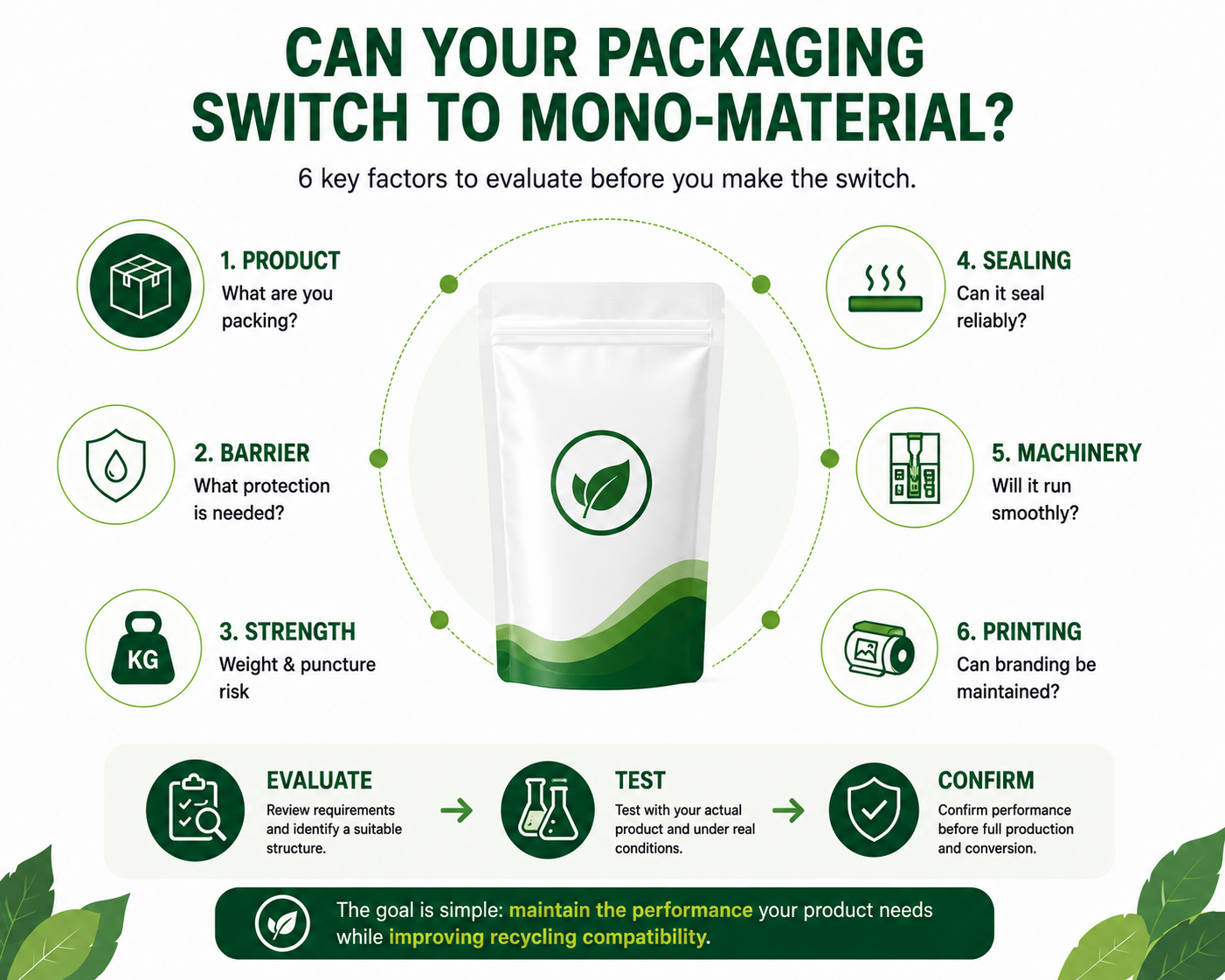
Can Your Existing Packaging Switch to Mono-Material?
Potentially, but the existing specification needs to be understood first.
Suppose you currently use:
PET / PE
Changing the specification to:
PE / PE
does not automatically create an equivalent package.
The PET layer may currently provide stiffness, heat resistance, dimensional stability or print-related properties. A PE-based replacement needs to deliver the functions that remain necessary.
This is why material conversion is better treated as packaging development, rather than a simple material substitution.
Several areas should be reviewed.
1. Start With the Product, Not the Material
The product determines the packaging requirement.
Before discussing PE/PE or PP/PP, identify whether the product is:
dry, frozen, oily, moisture-sensitive, oxygen-sensitive, heavy, sharp or irregularly shaped.
For example, a dry product with moderate barrier requirements may present a different conversion opportunity from vacuum-packed food requiring high oxygen protection.
The fill weight also matters.
A 500 g product and a 10 kg product may use the same polymer family but require completely different film thicknesses, seals and bag construction.
This is why material selection should start with the application rather than a sustainability claim.
2. Check the Barrier Requirements
Some products need packaging primarily for containment.
Others depend on packaging to help control exposure to oxygen, moisture, aroma, grease or light.
This can directly influence product quality and shelf life.
Multi-material laminates have traditionally been useful because different layers can provide different barrier functions.
However, mono-material does not automatically mean low barrier.
Commercial mono-PE and mono-PP structures are now available with oxygen, water vapour, light, fat and mineral-oil barrier properties for selected applications. Mondi, for example, markets mono-PE and mono-PP barrier packaging for food, pet food, snacks and other products, including structures designed for form-fill-seal applications.
Research has also demonstrated that coated PE-based mono-material structures can achieve strong oxygen and water-vapour barrier performance while maintaining mechanical properties comparable with conventional multilayer systems in the tested application.
But this should not be interpreted as “mono-PE works for everything.”
The correct question is:
Can the proposed structure achieve the barrier level required by this particular product?
That needs to be determined from the actual application and shelf-life requirements.
3. Consider Product Weight, Shape and Puncture Risk
Thickness matters, but thicker does not automatically mean stronger.
A bag’s performance also depends on the film structure, resin properties, seals, bag design and how stress is applied during use.
This becomes particularly important for:
frozen seafood, bone-in products, pet food, fertiliser, soil and industrial products.
A product with sharp or irregular edges can puncture packaging even when its total weight is relatively low.
Heavy products create another challenge because the bottom seal, side seals and film need to withstand the load throughout filling, lifting, stacking and transportation.
The required plastic bag thickness should therefore be determined together with product weight, shape and actual handling conditions rather than by micron alone.
4. Check Seal Performance
A package can have excellent film properties and still fail because of its seals.
This is especially important when changing materials.
The new structure may respond differently to temperature, pressure and dwell time during sealing.
Manufacturers should consider:
- Can the material achieve a reliable seal?
- Is the sealing window suitable for the production line?
- Does the seal remain strong after filling, storage and transport?
For automated production, consistency becomes even more important. A material that seals successfully during a small manual test may behave differently when the machine is running continuously at production speed.
This is why the finished package should be evaluated, not only the film sample.
5. Check Your Existing Packaging Machine
A technically recyclable film is not useful if it cannot run efficiently through the manufacturer’s packing line.
Changing the film structure can affect stiffness, friction, heat response, film feeding and forming behaviour.
Depending on the operation, trials may need to assess:
- film feeding and tracking
- forming
- filling
- sealing
- cutting
- production speed
- finished pack consistency
This does not mean switching to mono-material always requires new equipment.
Commercial mono-material structures are available for HFFS and VFFS applications and can be designed for existing packaging lines.
But compatibility should be tested rather than assumed.
6. Do Not Forget Printing, Ink and Adhesive
A common misconception is that once the main film becomes PE/PE, the entire package is automatically recyclable.
The complete design still matters.
CEFLEX’s 2025 guidance considers not only the polymer structure but also barrier layers, coatings, adhesives, inks, metallisation and tie layers. Its updated guidelines were developed using what it describes as its most extensive flexible-packaging-specific testing programme to date.
RecyClass also specifically evaluates printing inks and laminating adhesives in its PE and PP flexible packaging guidelines.
This is particularly relevant for heavily printed consumer packaging.
Brand owners still need strong shelf presentation, product information and colour consistency. The aim is therefore not to remove branding but to develop the complete packaging specification with recycling compatibility in mind.
Why Does Packaging Material Structure Matter?
Flexible plastic packaging can contain several layers because different materials provide different functions.
Some provide printability. Others provide sealing, strength or barrier performance.
From a recycling perspective, one important distinction is whether those layers remain within the same polymer family.
| Structure | What It Means for Recycling |
|---|---|
| PE/PE | Same polymer family; designed for better PE recycling compatibility |
| PP/PP | Same polymer family; designed for better PP recycling compatibility |
| PET/PE | Different polymer families; conventional recycling is more challenging |
| PA/PE | Different polymer families; recycling can be more challenging |
This is why simply saying that packaging is “plastic” does not tell you much about its recyclability.
For a deeper explanation, read our guide to mono-material vs multi-layer packaging.
PET/PE vs PE/PE: What Is the Practical Difference?
If PE/PE can deliver the required strength, barrier, seal integrity, print performance and production efficiency, it may provide a more recycling-compatible alternative.
If it cannot, forcing a conversion simply to make a recyclable claim is not good packaging engineering.
The objective is to remove unnecessary material complexity where technically possible, not to compromise product protection.
There is no universal winner.
The appropriate structure depends on what the product requires.
| Consideration | PET/PE | PE/PE |
|---|---|---|
| Main polymer structure | Mixed polymer families | PE-based |
| Mechanical recycling compatibility | More challenging | Better compatibility with PE stream when properly designed |
| Printing | Established performance | High-quality printing possible |
| Heat sealing | Good | Good when correctly specified |
| Barrier options | Established | Available for suitable applications |
| Best use | Where its properties are required | Where required performance can be achieved with a PE-based structure |
Does Mono-Material Mean the Package Will Definitely Be Recycled?
No.
This distinction is important, especially when businesses make environmental claims.
Mono-material packaging can be designed for recycling, but that does not guarantee every package will actually be recycled after consumers dispose of it.
Actual recycling also depends on the local system:
collection → sorting → recycling → demand for the recycled material
The design of the package determines whether it can work effectively within that system.
For example, RecyClass’s PE-film recyclability protocol tests whether packaging innovations can pass through pre-treatment, extrusion and conversion without negatively affecting the recycling process or the quality of recycled PE.
Colour can matter too. RecyClass notes that dark colours can affect near-infrared sorting efficiency and can reduce the ability to produce lighter-coloured recyclate later.
So rather than treating:
Mono-material = automatically recycled
the more accurate position is:
A well-designed mono-material structure can improve compatibility with the intended recycling stream, while actual recycling also depends on collection, sorting and recycling infrastructure.
This distinction makes sustainability claims more credible.
How Should Manufacturers Evaluate a Switch?
You do not need to redesign every package at once.
A more practical approach is to select a suitable product and work through the conversion systematically.
Step 1: Review the Existing Packaging
Identify the current:
material structure, thickness, dimensions, bag format, printing and annual quantity.
If the purchasing specification simply says “laminated pouch”, obtain the actual film structure first.
Step 2: Define the Required Performance
Instead of asking:
“Can you make this recyclable?”
describe what the packaging actually needs to achieve.
For example:
5 kg dry food, ambient storage, moisture protection required, printed packaging, heat sealed and transported by pallet.
That information gives the packaging manufacturer something meaningful to work with.
Step 3: Develop a Suitable Alternative
The supplier can then assess whether PE/PE, PP/PP or another structure can provide the required performance.
There may not always be a direct one-to-one replacement for the existing laminate.
Step 4: Test With the Actual Product
Testing should reflect real use.
Depending on the application, this may include sealing, filling, machine trials, freezing, stacking, transport or storage evaluation.
Step 5: Confirm Before Full Conversion
Only approve the new specification when it performs consistently under the required conditions.
The successful outcome is not simply:
“We changed to mono-material.”
It is:
“We improved the packaging’s recycling compatibility while maintaining the performance our product requires.”
When Does Multi-Material Packaging Still Make Sense?
Mono-material packaging is an important development, but multi-material packaging still has a role.
Some products have demanding requirements for oxygen barrier, temperature resistance, puncture resistance, shelf life or other functions.
If a proposed mono-material structure cannot provide those properties reliably, a multi-material laminate may remain the more appropriate solution.
This is particularly important in food packaging.
Packaging failure can create product damage, spoilage, food waste, customer complaints and additional material use. Improving one sustainability metric while significantly worsening another is not necessarily a better overall outcome.
This is why manufacturers should evaluate packaging based on the complete product-packaging system.
What Information Should You Give Your Packaging Supplier?
You do not need to know the final material structure before contacting a packaging manufacturer.
What is more useful is providing accurate information about the application.
For an initial assessment, prepare:
- product type
- fill weight
- current packaging material, if known
- bag or pouch format
- required shelf life
- ambient, chilled or frozen storage
- packing and sealing method
- printing requirements
- estimated order quantity
From there, the supplier can determine which structures are worth evaluating.
For businesses starting from a new specification, choosing the right plastic packaging for the product should consider these performance requirements before deciding on material, thickness or format.
Frequently Asked Questions (FAQs)
Is mono-material packaging recyclable?
Mono-material packaging is designed to improve compatibility with a particular recycling stream by keeping the main structure within one polymer family such as PE or PP. However, the complete package, including inks, adhesives, coatings and other components, should also be considered.
Is PE/PE considered mono-material packaging?
PE/PE can be considered a mono-material approach because the main film layers remain within the polyethylene family. The recyclability of the finished package still depends on its complete construction.
What is the difference between PE/PE and PET/PE?
PE/PE keeps the main structure within one polymer family, while PET/PE combines polyethylene terephthalate and polyethylene. Properly designed PE/PE therefore generally offers better compatibility with PE mechanical recycling streams.
Can food packaging use mono-material?
Yes. Mono-material structures are already used in food packaging, including real commercial applications in Malaysia. However, barrier, sealing, shelf life, food safety and storage requirements must still be evaluated for the individual product.
Can frozen food packaging switch to PE/PE?
Some frozen food products may be suitable for PE-based structures. The packaging still needs adequate cold resistance, puncture resistance, sealing performance and product protection, so testing under actual frozen conditions is important.
Will mono-material packaging work on my existing machine?
It may, but machine compatibility should be confirmed through trials. Film feeding, forming, sealing, cutting and production speed can all be affected by changes in film structure.
Does mono-material packaging affect printing?
Printed mono-material packaging is possible. However, inks, coatings, adhesives and print coverage form part of the complete packaging design and may influence recycling compatibility.
How do I know whether my current packaging can switch to mono-material?
Start with your existing packaging specification and product requirements. Enrich Package can evaluate the product, fill weight, storage conditions, sealing method, barrier needs and printing requirements to determine whether a PE/PE or PP/PP structure is suitable for testing.
Is Mono-Material Packaging Right for Your Product?
The decision to switch should not start with a trend or a recyclable label.
It should start with the product.
If a PE/PE or PP/PP structure can deliver the required strength, barrier performance, sealing, print quality and production reliability, mono-material packaging may provide a practical way to improve recycling compatibility.
Enrich Package manufactures recyclable plastic packaging in Malaysia, including PE/PE and PP/PP mono-material structures for suitable food, retail, agriculture and industrial applications.
If you currently use PET/PE, PA/PE or another multi-material laminate, share your existing specification and product requirements with our team. We can assess whether a mono-material structure is technically suitable for evaluation and testing.
Related Article:
Disclaimer:
We hope you found this article informative. Our content is intended for general informational purposes only and does not constitute advice or necessarily reflect the full range of services offered by Enrich Package (Malaysia) Sdn. Bhd.
Readers are advised to consult with a qualified industry professional and contact our experts for packaging recommendations specific to their individual business needs. While we strive for accuracy and completeness in our blog posts, we cannot guarantee they are error-free. Enrich Package (Malaysia) Sdn. Bhd. assumes no responsibility for any errors or omissions.